
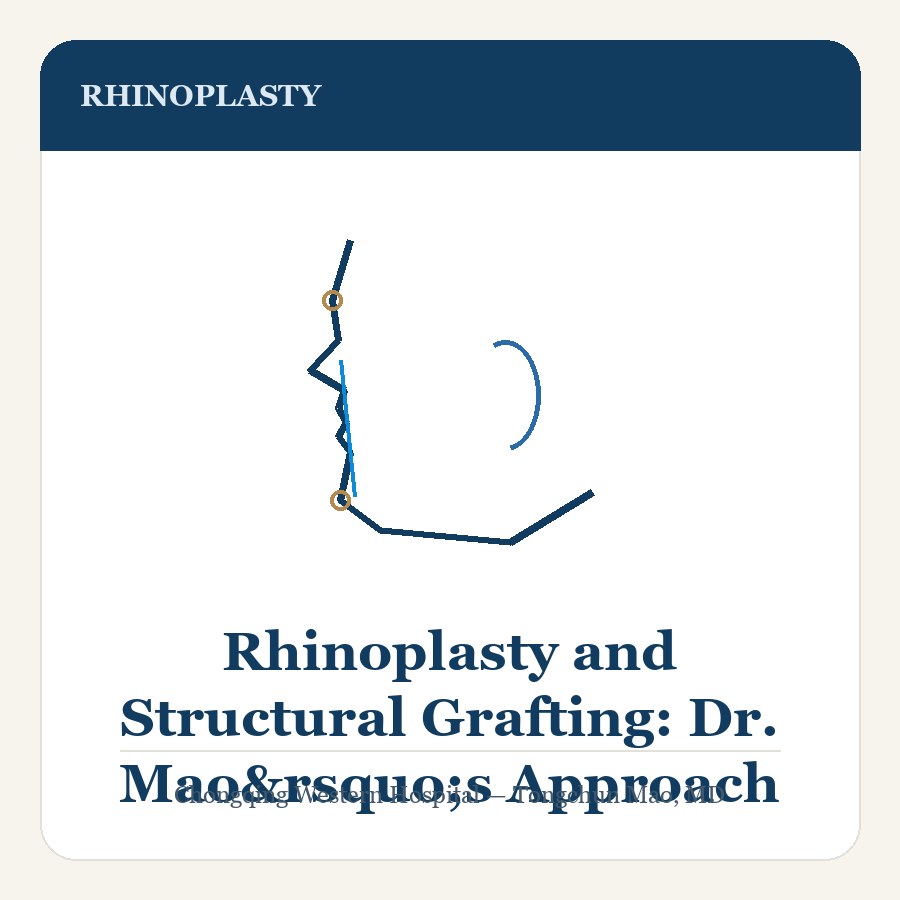
In short. How structural rhinoplasty rebuilds nasal support with cartilage grafts, why augmentation noses need structure rather than reduction, and what the operation honestly involves.
Key points
- Graft material comes from the patient’s septum, ear, or rib.
- Septal cartilage is the first choice when enough exists; ear cartilage suits softer contouring; rib cartilage provides volume for major reconstruction but carries a small risk of warping and a chest scar.
- Synthetic implants — silicone elastomer or ePTFE — can raise a bridge simply, but carry recognized long-term risks of movement, capsular contracture, skin thinning, and extrusion, especially when asked to support the tip.
Rhinoplasty is the centerpiece of Dr. Mao’s facial practice, and the philosophy behind it is structural: rather than only removing bone and cartilage, the operation rebuilds the nasal framework so the shape is held up by engineered support. This article explains what that means in practice and what it can and cannot deliver.
Why structure matters more than reduction
The nasal tip behaves like a tent: its shape depends on the strength of the cartilages and the septum beneath, not on the skin over them. Many patients who request rhinoplasty — particularly those with a low bridge, an undefined tip, or a short nose — need support added, not tissue removed. Cutting and weakening an already soft framework produces a nose that looks reasonable at six weeks and collapses or twists by two years. Structural grafting — columellar struts, septal extension grafts, tip grafts carved from the patient’s own cartilage — holds the shape against time and against thick skin.
Material choices, stated honestly
Cartilage for the tip, judgement for the bridge
Graft material comes from the patient’s septum, ear, or rib. Septal cartilage is the first choice when enough exists; ear cartilage suits softer contouring; rib cartilage provides volume for major reconstruction but carries a small risk of warping and a chest scar. Synthetic implants — silicone elastomer or ePTFE — can raise a bridge simply, but carry recognized long-term risks of movement, capsular contracture, skin thinning, and extrusion, especially when asked to support the tip. The consistent rule: the tip is supported by the patient’s own cartilage, never pushed up by an implant.
The operation itself
Structural rhinoplasty is usually performed through an open approach — a small incision across the columella — because grafts must be fixed under direct vision. The scar typically fades to a faint line but is permanent. Surgery is done under general anesthesia with full hospital monitoring and commonly takes three hours or more when cartilage harvest is included. A splint is worn for about a week; most patients return to desk work in ten to fourteen days.
What surgery can and cannot achieve
It can raise a bridge, project and define a tip, narrow a base, and straighten a deviation. It cannot thin thick skin, guarantee millimeter symmetry, or make one person’s nose belong to another face. Tip swelling is the slowest part of healing; in thicker skin the final definition may not declare itself for twelve months. Judging the result at six weeks leads to unnecessary anxiety.
Risks worth knowing
Beyond the general risks of surgery — bleeding, infection, anesthesia events — rhinoplasty carries specific ones: residual asymmetry, breathing difficulty, graft visibility through thin skin, warping of rib cartilage, and implant-related problems when synthetics are used. Published revision rates for rhinoplasty sit around five to fifteen percent, and revision is harder than the first operation because the tissue planes are scarred. These numbers are stated here because a consultation that omits them is not honest.
Arrange a surgical review if
- The skin over the bridge or tip becomes persistently red, shiny, thin, or painful, or an implant edge becomes visible.
- Fever, swelling, or discharge develops after augmentation — even years later, since late implant infection occurs.
- You are considering surgery while actively smoking, pregnant, or with an uncontrolled bleeding disorder — the plan must wait or change first.
Frequently asked questions
Why does structural rhinoplasty add support instead of removing tissue?
Because the nasal tip behaves like a tent: its shape depends on the strength of the cartilages and the septum beneath, not on the skin over them. Cutting and weakening an already soft framework produces a nose that looks reasonable at six weeks and collapses or twists by two years.
Which cartilage is used for the grafts?
The patient’s own septum, ear or rib. Septal cartilage is the first choice when enough exists, ear cartilage suits softer contouring, and rib cartilage provides volume for major reconstruction but carries a small risk of warping and a chest scar. The consistent rule is that the tip is supported by the patient’s own cartilage, never pushed up by an implant.
How long before the result of a rhinoplasty can be judged?
Tip swelling is the slowest part of healing, and in thicker skin the final definition may not declare itself for twelve months. Judging the result at six weeks leads to unnecessary anxiety. Published revision rates sit around five to fifteen percent, and revision is harder than the first operation because the tissue planes are scarred.
Risks & Limitations
- Bruising and swelling lasting weeks; after bone surgery, months pass before the final result is visible.
- Scars are permanent. They mature and fade over 6–12 months but never disappear.
- Numbness or altered sensation, which may be temporary or, after bone or nerve work, lasting.
- Asymmetry, under-correction or over-correction; final assessment is made at 6–12 months.
- Infection, bleeding or haematoma, which may need drainage or antibiotics.
- Breathing changes after nasal surgery, which may be temporary or require further treatment.
- Revision surgery carries higher risk and is less predictable than a first operation.
When to Seek Care
- Difficulty breathing or shortness of breath — seek emergency care immediately.
- Rapidly expanding swelling, or a tense, painful, tight area.
- Fever above 38 °C, spreading redness, warmth or pus.
- Bleeding that does not stop with gentle pressure.
- Any sudden change in vision after facial surgery or a facial injection.
References & Further Reading
- American Society of Plastic Surgeons (ASPS) — procedure and safety guidance
- International Society of Aesthetic Plastic Surgery (ISAPS)
- National Institute for Health and Care Excellence (NICE, UK) — relevant guidance
- Cochrane Library — systematic reviews in facial plastic surgery
This page is patient education, not medical advice, and it does not cite individual studies. Discuss your own case with a qualified clinician. To arrange an assessment at Chongqing West District Hospital, see Contact & Consultation.